SPARKLE Guimarães School – Local Governance
A green transition for all: empowering participatory governance for future-proof cities
 Local governance
About

How can climate and energy planning become truly impactful in our cities?
Through citizen engagement, integrated planning, and multi-level governance, municipalities can support the design and implementation of effective, long-term climate strategies to build a secure and sustainable future.
Would you like to be inspired and exchange with pioneering cities that have put citizens at the heart of the energy transition? Then, don’t miss the opportunity to join the SPARKLE School A green transition for all: empowering participatory governance for future-proof cities, taking place on 28–29 April 2026 in Guimarães, Portugal, EU’s Green Capital 2026. Scroll down to discover the agenda and learn how to apply for the fully funded scholarship.
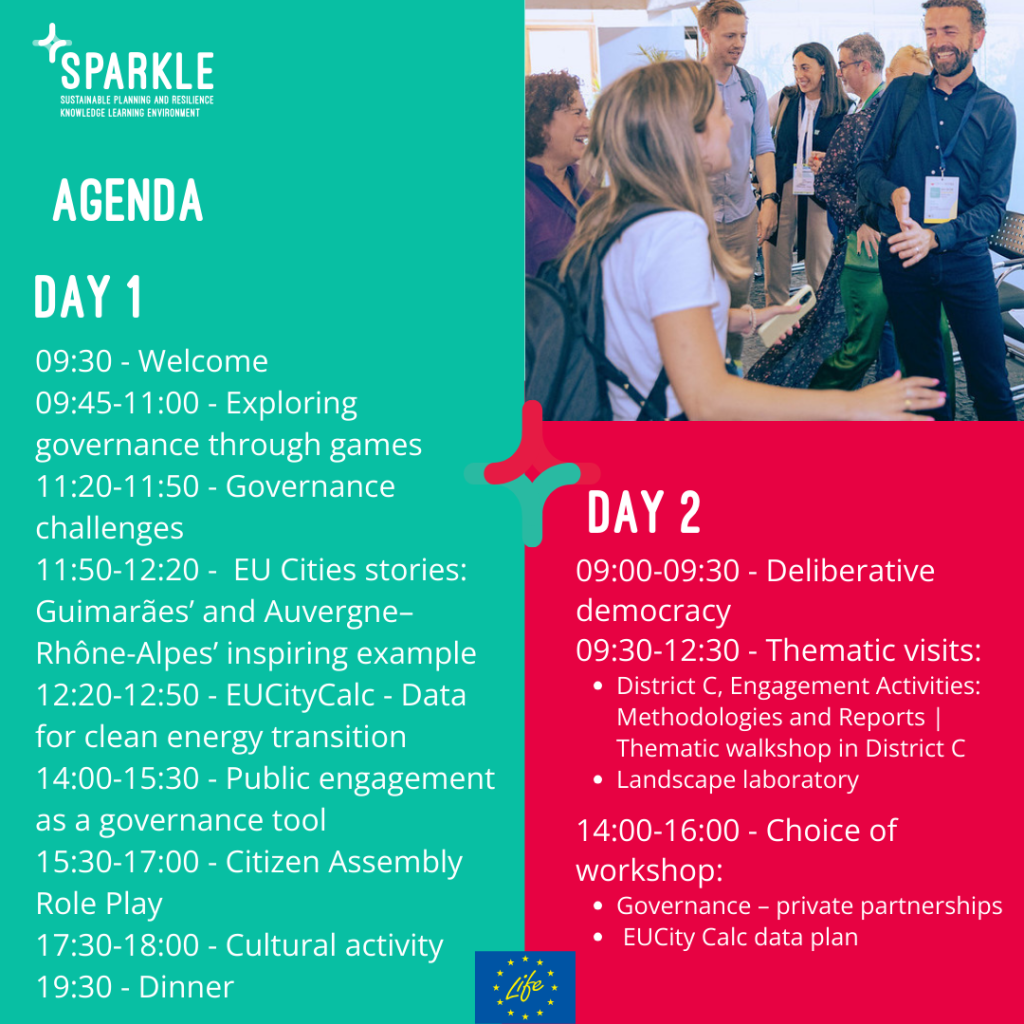
Day 1 – Public engagement as a governance tool
On 28 April, we will explore governance through interactive games, sharing challenges, and hearing from pioneering local and regional authorities, including Guimarães and Auvergne–Rhône-Alpes, on how they place citizens and SMEs at the heart of the transition.
Noora Firaq, Board Director of Westmill Wind Farm Co-operative and expert on Article 12 of the UN Paris Agreement on citizen engagement, will focus on citizens’ assemblies and public engagement initiatives from around the world.
Finally, we will examine how to collect and use city data as a governance tool for informed decision-making. SPARKLE’s technical partner Climact will support you in mapping a local transition pathway using EUCityCalc, linked to your city’s SECAP.
A cultural visit, a solution exhbition and a networking dinner will conclude this first day.
Day 2 – From theory to practice
On the second day, we will experience engagement first-hand by visiting Bairro C – Compromisso Carbono Zero (District C- Zero Carbon Commitment). This thematic walkshop will showcase Guimarães’ participatory approach, focused on involving both citizens and SMEs in setting sustainability priorities and designing solutions through citizen assemblies. We will also visit the Laboratório da Paisagem (Landscape Laboratory), a former industrial site transformed into a sustainability model where multiple stakeholders connect research, policy, education and community engagement.
After lunch, you will learn how to develop a shared vision for private sector engagement in local climate policies, clarifying the respective roles of cities and companies in this collaborative pathway. Alternatively, you may choose a parallel workshop to develop a detailed transition plan for their city using EUCityCalc modelling tool.
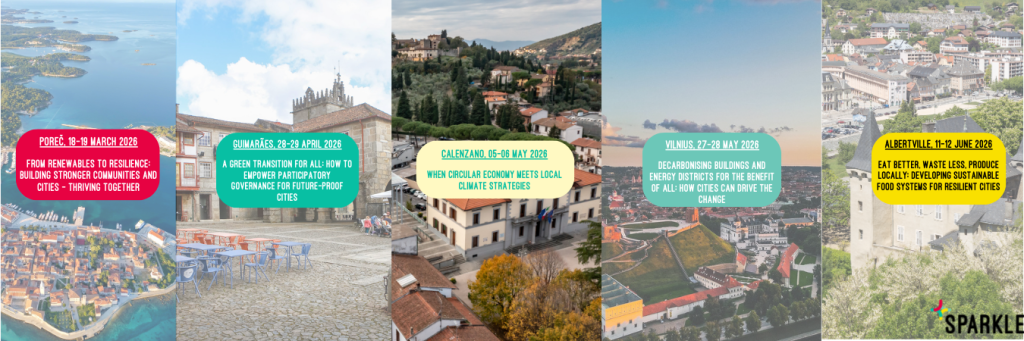
How to apply
To join us, you need to apply by 17 February 2026. You can either join as a self-funded participant, or – if you are a local/regional authority that meets all the eligibility criteria – we will cover your travel expenses up to € 1.400. To apply for the fully funded programme, you need to:
- Complete the SPARKLE free e-learning Integrated energy and climate transition planning course in addition to either the Data for a clean energy transition or the Transition management course.
- Fill out the application form and indicate the school (first and second choice) you would like to attend.
- Provide a Letter of Commitment demonstrating your municipality’s ambition to develop or improve a SECAP or similar plans and to participate in the chosen SPARKLE school.
- Indicate 2 representatives (one technical and one political delegate) to join the selected school.
Selected participants will be notified by 17 March 2026.
Click on the button below to discover the selection process and learn more about the other schools!
Energy Cities’ Annual Forum – Nurturing roots
These study visits on the second day are part of Energy Cities’ Annual Forum, taking place in Guimarães from 28 to 30 April. This international event offers a valuable opportunity to network with peers while exploring key themes of the green transition relevant for public officers and energy professionals. Save the date: registrations and the full programme will be available from February!