While the EU is discussing the next EU budget, Heidelberg joins the #MadeForFuture Campaign to highlight the importance of local authorities in implementing EU priorities.

The Multiannual Financial Framework (MFF) is the EU’s seven‑year plan that guarantees financial stability and directs funding towards key priorities such as cohesion, innovation and sustainability. The 2028‑2034 Budget will be crucial for meeting the EU’s 2030 climate targets, staying on track for climate neutrality by 2050, and unlocking the massive local investments required to get there.
Yet, despite implementing over 70% of EU legislation, cities and regions are largely sidelined in the current proposal.
Energy Cities has joined forces with seven other networks of local and regional authorities through the Local Alliance to advocate for a stronger territorial dimension to the next EU Budget.
The current MFF proposal, by sidelining cities and regions, risks undermining Europe’s ambitions, by:
After years of encouraging cities to plan and invest in the climate transition, the proposal risks keeping funds at national level and depriving local authorities of the resources needed to deliver EU climate goals. Regions, cities and towns are co-pilots of Europe’s transformation – driving the clean energy transition, providing affordable housing, promoting sustainable mobility and building resilience to climate change.
Cities and regions shape the infrastructure, services, and skills that enable businesses and industries to thrive. Recognising local governments as investors and innovators strengthens Europe’s competitive advantage and evens out economic development across territories.
By centralising decision-making at EU and national levels, the proposal is cutting off Europe’s direct link to its citizens via its local governments. For Europe to safeguard democracy, it needs to equip its cities and regions to deliver democracy daily with a budget of the people, for the people.
The negotiations will run until the end of 2026, with finalisation expected by March 2027 at the latest. Member States are moving very quickly to define their positions in the Council.
To influence the negotiations, it’s crucial for local authorities to advocate at national level. Energy Cities has put together a toolkit to help local actors with their national advocacy efforts.
We have started producing national factsheets providing a preliminary overview of the proposed allocations under the National and Regional Partnership Plans for ‘cohesion,’ the Common Agricultural Policy (CAP), and Home Affairs. These documents outline potential budget lines for various interventions; however, please note that these figures are provisional. As the total Multiannual Financial Framework (MFF) amount is currently under discussion in the Council, all budget lines remain subject to significant variation.
Additionally, please be aware that these projected budgets do not represent the entirety of funds available for local transition. Not all allocated funds will reach the local level, while other budget sources may become available. Therefore, continued advocacy remains essential to secure necessary funding for local transition.
You do not see your national factsheet and you would like to have it? Write to us!
Across Europe, cities and regions turn EU investment into real solutions, from cleaner energy and mobility to resilient infrastructure and urban design. The #MadeForFuture Campaign shows why having a strong local and regional approach to the next MFF is essential to keep delivering for citizens.
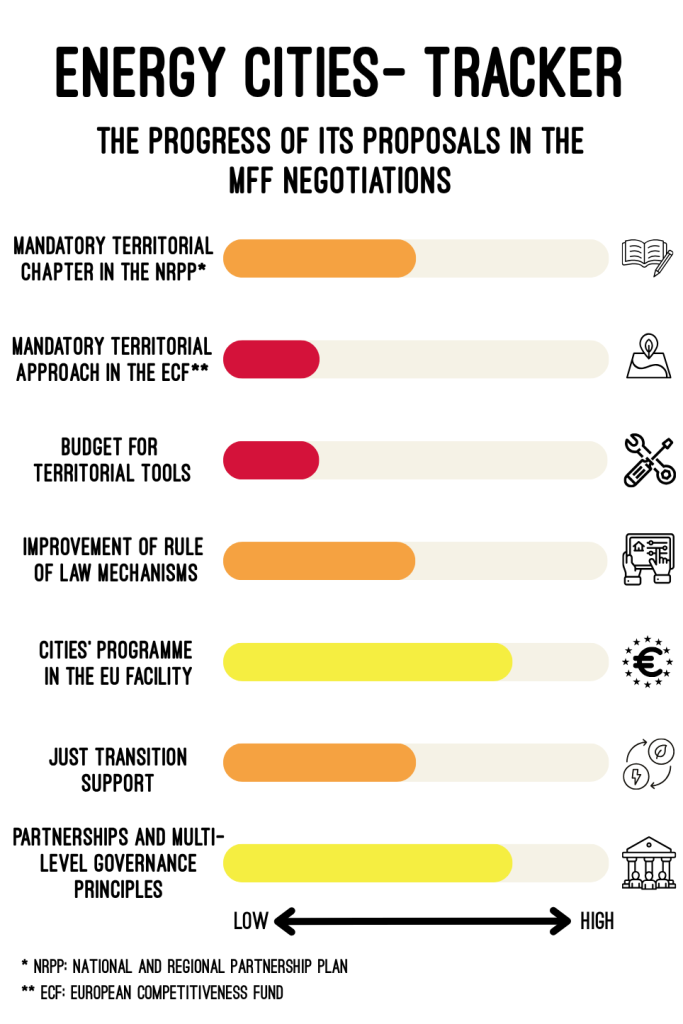
20 October 2026 – The Irish Presidency of the Council proposed a comprehensive solution, with an 8% cut to the European Commission’s proposed budget, leaving agriculture and regional policy untouched. The proposal do not convince neither part at the Council, nor the Parliament, nor the European Commission.
15 April 2026 – The Budgetary Committee of the European Parliament approved the Interim Report on the MFF. As decided by the Parliament’s political leaders, the Interim Report will shape the Parliament position in the negotiations with the Council.
22 January 2026 – The European Parliament chose its rapporteurs and shadow rapporteurs for all the MFF-related files.
Find out who they are in our list of key MEPs that we created as part of our Mobilisation Kit!
14 November 2025 – The European Parliament pushed back on the Commission’s original proposal, securing improvements such as:
Further changes are essential to ensure the budget truly reflects Europe’s territorial diversity.