How a small French town grows an energy sharing culture
In Malaunay it all began with solar panels on a church rooftop
 Community energy
About

What if homegrown energy did not start with a million-euro smart city strategy, but with a municipality struggling to pay its bills?
That was the reality in Malaunay, a small town near Rouen in France. It all started in 2012, when rising energy costs forced local leaders to rethink the town’s future. Instead of scaling back ambitions, the city council made a bold decision. Find out what happened and see how today, the municipality is proving that even small towns can lead the way in electricity sharing.
Malaunay’s story, the second of our Homegrown Energy campaign series, offers a practical lesson for municipalities across Europe: start small, build trust, and grow step by step.
The wake-up call
Back in 2012, Malaunay could no longer afford its energy bills. The situation became a wake-up call. Instead of cutting ambitions, the city council decided to invest in energy savings and local renewable energy production. Malaunay’s first move was simple but strategic: improve energy management in municipal buildings. The town renovated around 80% of its public building stock and began installing solar panels on municipal roofs.
A major breakthrough came in 2016, when the municipality secured a €2 million national grant — equivalent to half of its annual budget. The funding allowed the city council to install 300 kWp of solar PV across nearly all municipal roofs, covering 1,700 m². One of the most symbolic installations was placed on the town church. The solar electricity produced was primarily self-consumed. Any surplus was shared with other municipal buildings.
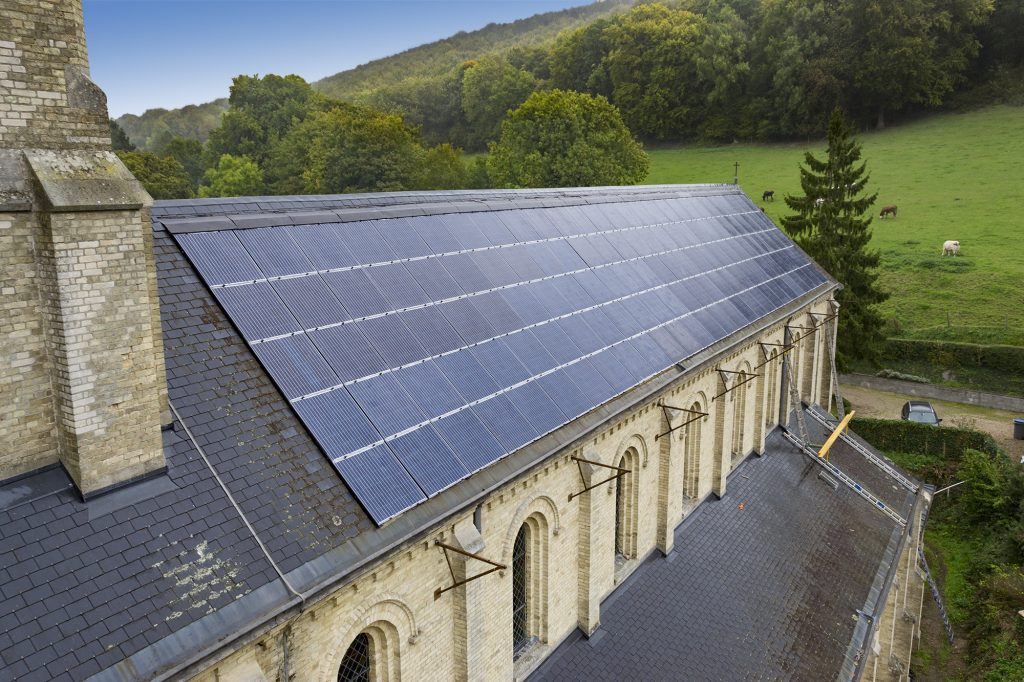
At the same time, the municipality replaced gas heating in public buildings with biomass heating plants fuelled by woodchips, now covering up to 62% of heating needs. But Malaunay did not stop at producing renewable energy for municipal consumption. The town wanted local energy to benefit the wider community.
Energy made and shared locally
The municipality launched one of France’s first electricity sharing schemes using municipal buildings. Malaunay quickly realised that that was not enough. The town wanted residents and local organisations to become part of the story too. Residents were encouraged to install their own solar panels and become “prosumers” — producing more electricity than they consumed and sharing the surplus locally. To make this happen, the city council played several roles at once: facilitator, investor, partner and trusted local anchor.
Small town, big results
- In 2025, Malaunay generated 223 MWh of solar electricity. Around 84% was directly consumed by municipal buildings through self-consumption and the collective sharing scheme. Solar power now covers 41% of the municipality’s electricity needs.
- The town saves more than €51,000 every year thanks to its photovoltaic system. These savings help protect the municipal budget from unstable energy prices.
But the biggest change may be less visible. The project has attracted new residents into community life, including people who had never previously been involved in local initiatives.
What other municipalities can learn
Malaunay’s story is not a story about having all the answers from the start.
The municipality relied on external legal and technical experts, trained its own staff, and accepted that building an energy community takes time and patience. Most importantly, the town started with what it already had: public buildings, motivated local leaders and a willingness to involve people.
That is perhaps the strongest lesson from the Homegrown Energy campaign so far. Local energy transitions do not grow overnight. Like a garden, they start with seeds and require patient gardeners.
Find the detailed case study and other tips to nurture your local garden on the Homegrown Energy Campaign site.
This information campaign is organised together with the EU Covenant of Mayors. Each month, we bring new stories and fresh angles on how local municipal teams manage to overcome concrete obstacles to create hyper-local, community-anchored energy services that create long-term benefits for the area.